
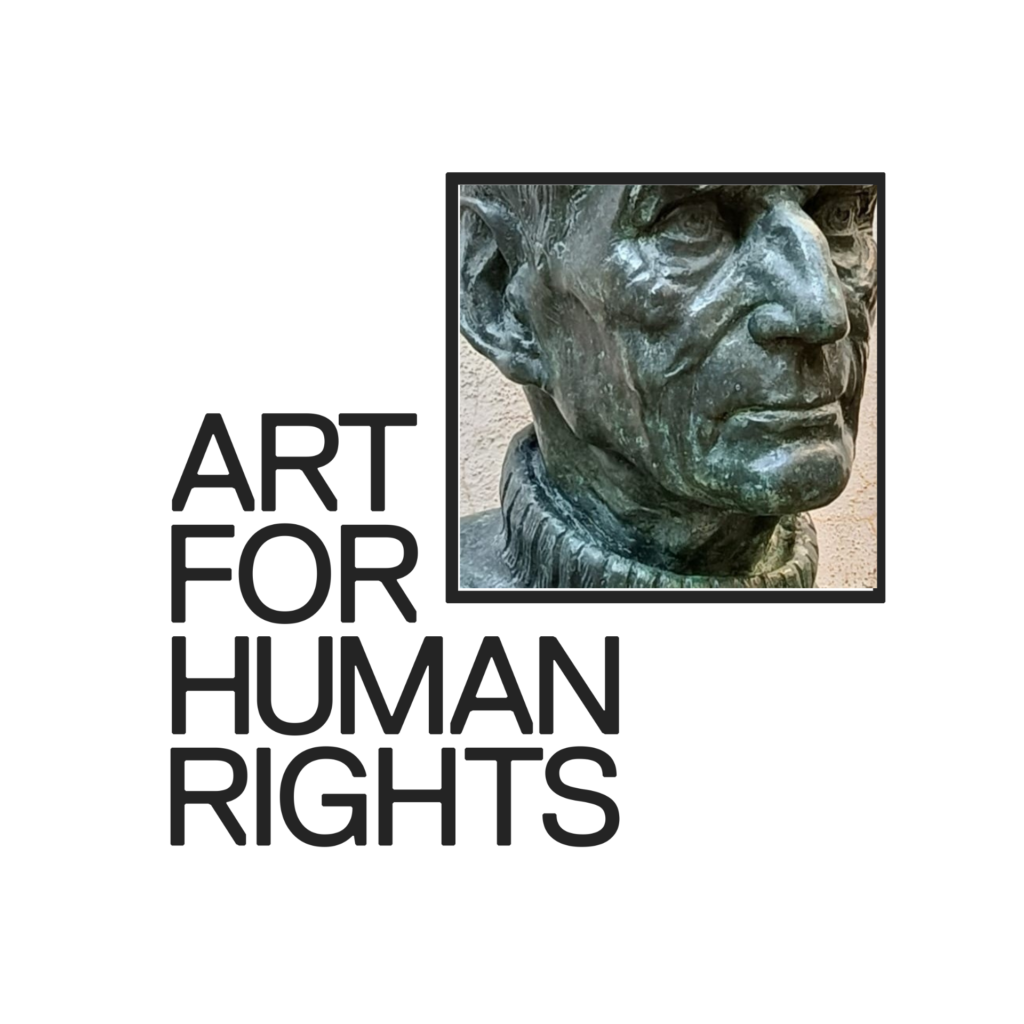
To mark the creation of a new bronze bust of Samuel Beckett by Czech sculptor Marie Šeborová commissioned by Art for Human Rights founder Bill Shipsey, Aika Boroli writes about Beckett the ‘Resistant’ in France during World War 2.
Four casts of the bust have been created so far, all for France. One each for Roussillon, where he sheltered from 1943-45, for Ussy-sur-Marne where he built himself a country cottage in the 1950’s, for the Atelier Samuel Beckett in Mericourt-sur-Seine and for the Garden of the Irish Embassy in Paris.
Samuel Beckett’s lessons of resistance for today…
Samuel Beckett spent much of his career writing about characters who wait, hesitate, and struggle to act meaningfully. In 1941, he did something almost none of his fellow writers dared to do: he joined the French Resistance against the Nazi occupation. It was a choice that was neither expected of him nor required, and one that still reads as a striking act of moral courage.
In the early 1940s, Beckett was living in occupied Paris, relatively safe. As a citizen of neutral Ireland, he had no legal obligation to oppose Vichy or the Nazis, and most writers and intellectuals of the time chose silence or neutrality. Resistance was rare, especially in those early years, when the risks were highest, and an Allied victory was far from certain. Only a small fraction of the French population ever took an active part.
Beckett chose otherwise. In 1941, alongside his partner Suzanne Deschevaux-Dumesnil, he joined the “Gloria” network, working as a courier and translator who turned intelligence into English for the Allies. It was dangerous, unglamorous work, not a symbolic gesture. When the network was betrayed, Beckett and Suzanne had to flee Paris and hide in the south of France. What makes the decision remarkable is its timing: he committed before resistance was widely supported, before there was any assurance the Allies would win.
That timing is exactly why his story still matters. Modern authoritarianism rarely announces itself as clearly as Nazi occupation did. It tends to arrive gradually, through the erosion of democratic institutions, quiet restrictions on civil liberties, the spread of misinformation, and the targeting of minorities. The pace is often slow enough to let people convince themselves the moment for action hasn’t yet arrived.
Beckett’s example pushes back on that instinct. When he joined the Resistance, there was no guarantee it would matter. Looking back, the moral clarity of World War II seems obvious; lived from the inside, the outcome was anything but certain. He acted without knowing whether history would vindicate him.
This is also where his story intersects with human rights more broadly. Rights rarely vanish overnight, they erode. Governments expand surveillance in the name of security, narrow free expression, or apply the law unevenly while still claiming to governdemocratically. It’s easy, in the midst of that, to tell yourself the situation isn’t yet seriousenough to warrant action. Beckett’s life is a reminder that waiting for injustice to become undeniable often means waiting until it’s too late.
There’s a further lesson in the shape of his resistance: it wasn’t dramatic. Beckett wasn’t a military commander or a public orator. He translated documents and carried messages, modest tasks that turned out to be essential. His example suggests that resisting injustice is rarely a matter of grand gestures. More often, it’s built from smaller, steady acts: defending accurate information, supporting vulnerable people, speaking against discrimination, staying engaged in civic life.
There’s also a quiet symmetry between Beckett’s writing and his wartime choices. His plays return again and again to uncertainty, isolation, and waiting, yet his characters keep going rather than giving up. His actions during the war carry the same logic: he didn’t act because success was guaranteed, but because it was right.
At a moment when authoritarian movements are gaining traction and power in many parts of the world, Beckett’s life poses a pointed question: when does silence become complicity? His own answer, implicit in what he did, is that the line comes sooner than most of us would like to believe.
To remember Beckett only as a playwright is to miss half the story. He was also a man who chose to resist oppression when doing so was dangerous and unfashionable, proof that defending human rights doesn’t always require grand gestures or famous leaders. Sometimes it starts with ordinary people making hard choices before they know how the story ends.