
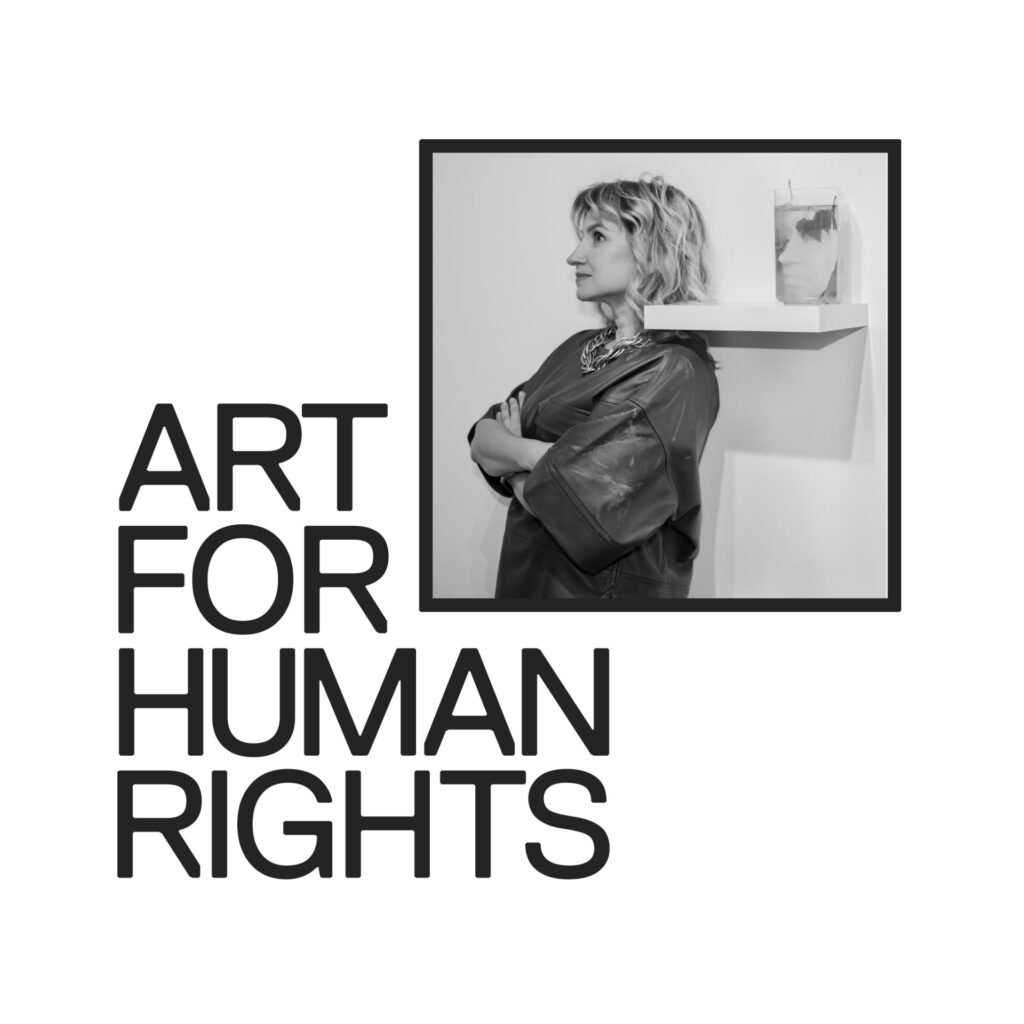
Maria Gvardeitseva on exile, belonging, and the radical freedom of making art as an outsider.
She arrives in conversation the way she told me she moves through exhibitions — fast, alert, already thinking three steps ahead. But then something catches her, and she stops completely, and we are honoured to have made her stop with us for an interview. That quality, the ability to be genuinely arrested by something, feels like the key to understanding Maria Gvardeitseva’s work: wax votive figures, performances soaking men’s suits in a vivid blue, dried herbs mixed with strands of natural human hair and sealed under layers of latex. “Those wow moments are what I’m hunting for,” she tells me. She succeeds in making you stop to try to understand, to think, and to be critical; she makes you stop to be human again.
We met on the 7th of March in Paris, where she had come for a few days to celebrate a friend’s birthday. A visit that had been packed with exhibitions (meticulous choices not to overwhelm her not-so-art-obsessed friends), carefully chosen restaurant reservations, and a grand finale at the Opéra Bastille to see Puccini’s Tosca. I caught her briefly in the hotel café, between the city and whatever was next.
Born in Minsk in 1982, Gvardeitseva now lives and works in London. Her practice — spanning sculpture, installation, performance, video-art and writing — has been shown across Europe, from the Mark Rothko Art Museum in Latvia to the Museum of Free Belarus in Warsaw. She was a finalist for the Belarusian Pavilion at the 59th Venice Biennale in 2022, but her project was censored due to her political ideas. That same year, she renounced her Belarusian citizenship.
Maria has lived across seven countries. She speaks about belonging with the clear-eyed pragmatism of someone who has spent years trying to want it and finally made peace with not having it.
Her last visit to Belarus was in March 2020, just before the world closed. The crackdown on protests that followed the disputed 2020 elections, and Belarus’s deepening role in the war in Ukraine, made her criticism towards the government a barrier to exhibiting her work in the Belarusian pavilion of the Venice Biennale 2022, a pavilion which ended up not opening that year.
“In 2022, I resigned my Belarusian citizenship,” she says matter-of-factly. “It’s quite a process — it takes about half a year, and it’s expensive. I received a personal decree from Lukashenko, signed by him, for me to exit my citizenship.” She lets the absurdity of that sit for a moment. A piece of paper from a dictator, releasing her from a country that had already released her. She also acknowledged the privilege of her act; she had a European passport to fall back on and the resources to see her heavy-hearted desire become real.
“The feeling of belonging is one of the strongest in human nature,” she says. “It’s very natural to try. But I’ve lived in so many places — it takes years, it takes decades. After three years in the UK, I realised it would take another thirty to become local, and I don’t have that time. And I realised: I’m fine with that.”
There is no performance of loss in the way she says this. She genuinely means it. The outsider identity, she has found, carries its own advantages: a kind of helicopter overview, an ability to take and give without merging into one singular version of herself. She moves through the world, she says, with so many identities inside her that the identity of an outsider has simply become one more to inhabit. “But I still think my overview, my vision — it might be interesting to any society I live in. And I bring it to my artistic practice.”
I ask if she could imagine going back, if things were to change politically. Her answer is immediate and unambiguous. “The home that I love exists only in my memory. It’s not there anymore. It’s a different reality, and I’m very clear about it. Honestly, I’m very pessimistic about its future.”
This pessimism does not reach Eastern Europe’s place in Western cultural discourse. “Eastern European art is booming right now; it is a newly discovered scene,” she says. But being Eastern European is not just a political definition. It’s another approach, another mindset. “We’re considered privileged because of skin colour, but a Slav has the same etymological root as the word slave, because most slaves historically came from that region. White doesn’t mean belonging to the global North. We have our own stories, and I think that’s something genuinely interesting that we can bring.”
Part of these stories will be shared in Photo London 2026, through the collective built two years ago by Polish visual artist Zula Rabikowska, Rethinking Eastern Europe. Through mixed-media creations and the varied perspectives of artists from Central and Eastern Europe, the Balkans, and the diaspora, this exhibition will explore the shared themes of memory, belonging, and intergenerational history.
In a time of geopolitical shift and rising nationalist discourses, it is relevant to understand both the unique components of these movements in each country, but also specially compelling to be aware of parallelisms. The rise of the far right across Europe and the United States runs through our conversation like a low current. She names Italy, Hungary, Spain, Poland, Moldova, and the US. She speaks about it with the particular urgency of someone who listens and pays attention, of someone who cares.
“The only way to raise children and create democratic societies is through education, critical thinking and kindness,” she says. “When extreme right forces come to power, we see a big lack of critical thinking. And with social media amplifying that, we see the manosphere and right-wing politics becoming mainstream discourse. That’s terrifying.”
Against all of this, she positions art not as escapism but as structural resistance.
“Art is the last space for freedom, for showing different approaches and different views. Governments, big corporations, they would like us to think in certain ways, to make decisions in certain ways, to be obedient. Art is something that brings different approaches to the table. And I feel it’s totally fine for art to expose you to uncomfortable feelings. That’s how you start thinking differently and appreciating different opinions.”
Her own practice enacts this. She describes encountering messages before artworks when she enters an exhibition, her own included. The work she creates is always conceptually driven, rooted in complex and often uncomfortable stories. Her project, The Adoration of the Mystic Goat — shown at the Museum of Free Belarus in Warsaw in 2024 — reflects on her fading Belarusian identity through the lens of medieval crusaders returning to Spain after decades abroad: strangers in their own homeland, who created altarpieces from the objects they’d carried back, combining different worlds into a single act of worship. “They were migrants, even in medieval times,” she says. “It was such an inspiring story.”
Her inspirations are nature, reading, and opera — the last of which is like her own practice, unapologetically synthetic: music, voice, text, set design, costume, spectacle, all at once. I think about Tosca, waiting for her later that evening at the opéra. A story about a woman’s refusal to submit to power, set against state violence and political repression. It does not seem like a coincidence.
We end on what she says her practice ultimately is: seeing invisible connections between things, people, and ideas that are not immediately obvious. “That’s how new artistic projects are born,” she says. “We are all connected in this world, and to see those non-obvious connections, I find that so inspiring.” A week after the photographs taken by Artemis II of the singular planet we all live in, choosing a lens of connection lands not in any way radical, but as absurdly unavoidable and extraordinarily beautiful.